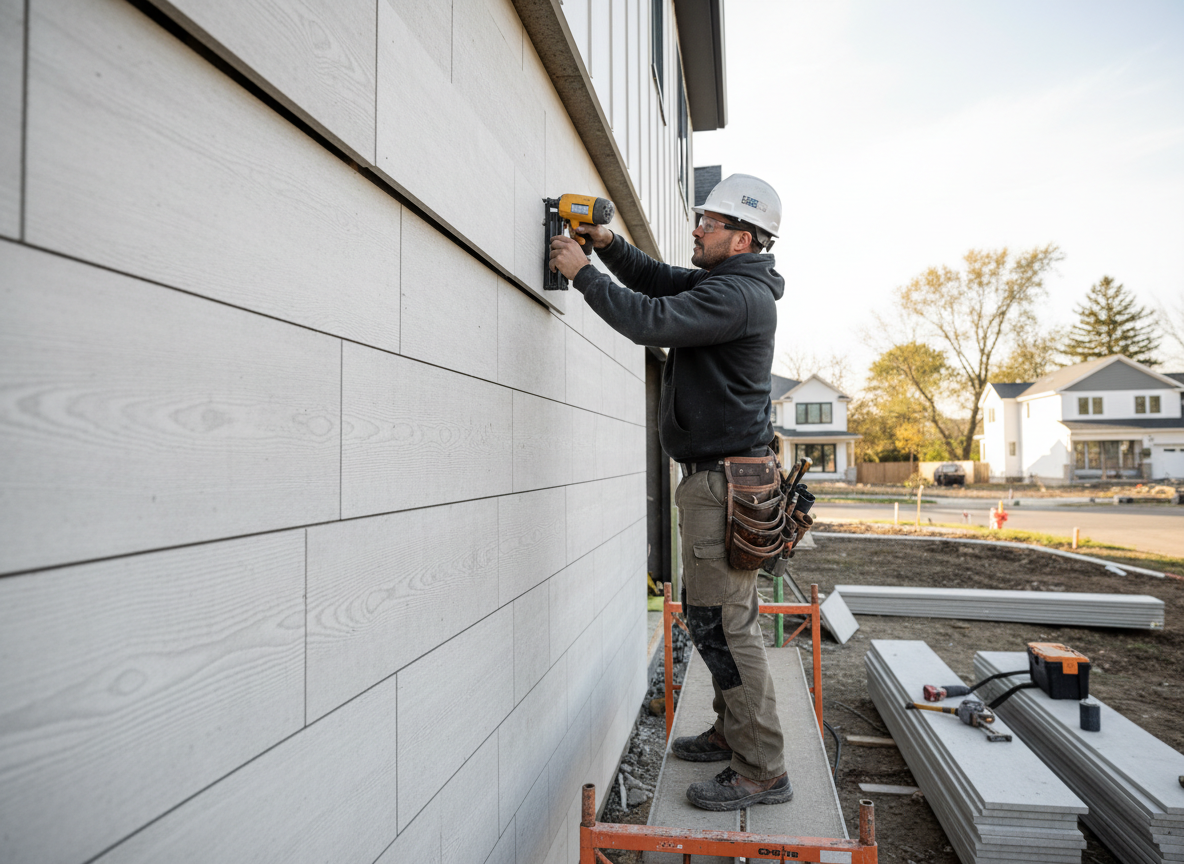
Concrete board siding, also called fiber cement, holds up well in Boone County's humid subtropical climate where mild winters still bring enough moisture to stress older wood siding on homes built in the 1980s and 1990s around Union and Ryle. Proper installation requires leaving expansion gaps at every joint and using corrosion-resistant fasteners because the area's occasional freeze-thaw cycles can push boards if they are butted tight. Homeowners near Union Community Park often see paint failure first on south-facing walls where afternoon sun heats the material and then humidity slows drying.
When replacing existing siding on Burlington Road or Florence-area properties that feed into Union, crews must check sheathing for rot caused by past gutter overflow or poor window flashing. Concrete board is heavy, so older homes with 2x4 framing need additional nailing strips or plywood reinforcement before new panels go up. Local building practices in Boone County also call for housewrap seams taped and integrated with window flanges to keep wind-driven rain from reaching the studs during summer storms.
Edge details matter most at gable ends and around vents where concrete board meets dissimilar materials. Cutting dust is a real concern on job sites in residential neighborhoods, so crews use dust-extraction saws and wet methods to avoid coating nearby vehicles or lawns. Once installed, the siding accepts any quality exterior paint, but the first coat must be applied within the manufacturer's time window to maintain the warranty on the substrate itself.
Technician insight
In Union, the thing that catches most people out with concrete board siding is how the combination of humid summers and mild winters lets water sit behind poorly flashed windows on 25-year-old homes near Ryle, turning a simple re-side into a sheathing job once you open the wall.
Concrete Board Replacement on a Union Home
Homeowner near Union Community Park reported cracking boards on the rear elevation. Inspection showed water behind the panels from failed window flashing installed during the original build. We removed the damaged concrete board, replaced rotted sheathing, added proper flashing, and installed new panels with sealed joints suited to Boone County humidity. The repaired wall now sheds water without trapping moisture.
How it works
- 1
Site Assessment
Measure elevations, note existing sheathing condition, and check for moisture issues common on Union homes after humid summers.
- 2
Material Selection
Choose thickness and texture that match the home's age and neighborhood style while accounting for Boone County wind exposure.
- 3
Prep and Flashing
Remove old siding, repair sheathing, install new housewrap and window flashing to handle local humidity and mild winter rain.
- 4
Installation
Hang panels with proper gaps, fasten per code, and seal joints before final paint.
- 5
Final Walkthrough
Review drainage details and touch-up points with the homeowner.
Pricing
Pricing varies with square footage, existing damage, and access on Union and nearby Boone County properties.