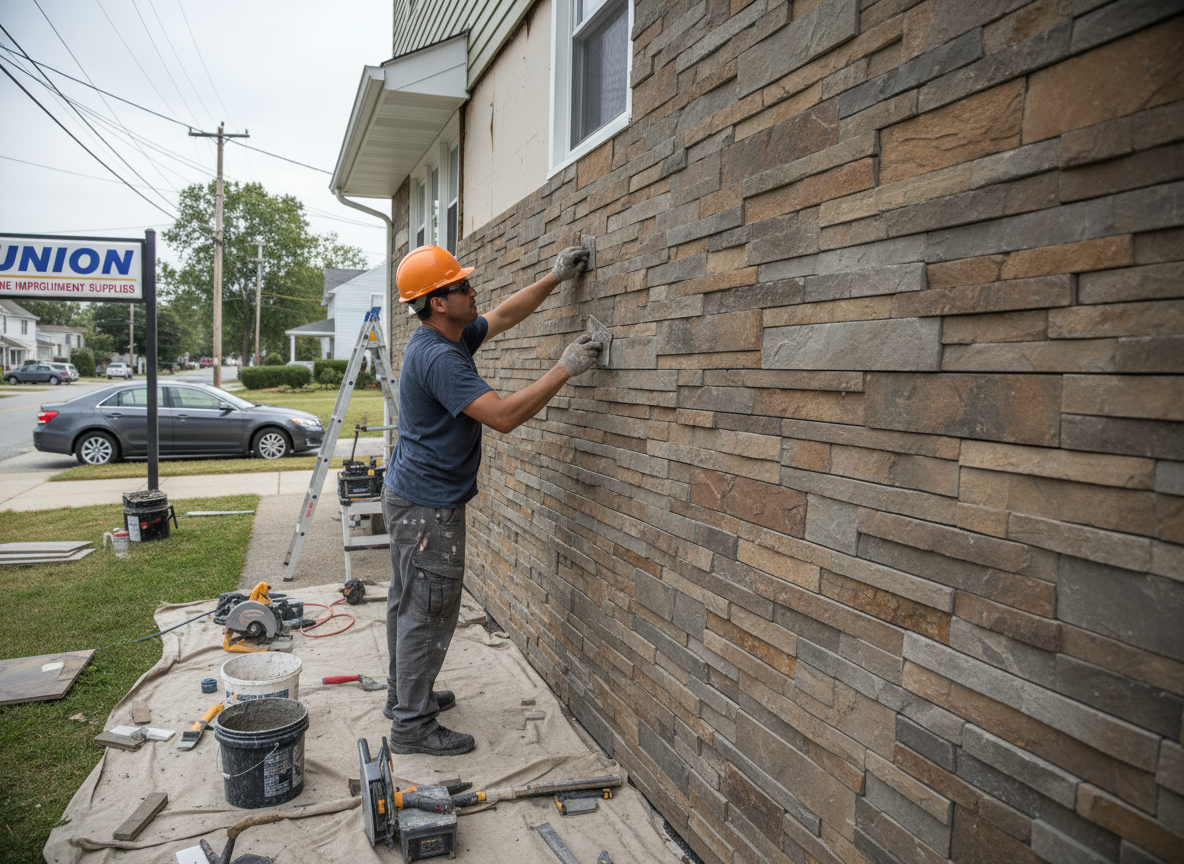
Fake stone siding on Union homes must handle the humid subtropical climate where summer humidity drives moisture behind panels and mild winters still produce enough freeze-thaw cycles to stress mortar joints. In neighborhoods around Union Community Park and Ryle, many houses built from the 1980s onward have vinyl or wood siding that has begun to cup or delaminate; switching to lightweight manufactured stone requires removing the old material, checking sheathing for rot, and adding a proper drainage plane before new panels go up. Boone County building codes now require a minimum 3/8-inch air gap behind stone veneer on any residence, so installers tape all seams and install weep screed at the base to prevent water from sitting against the foundation.
Terrain around Union slopes gently toward the south, so water runs toward crawl spaces on many Ryle properties. When installing fake stone, crews pay special attention to grading and extend flashing at least six inches past grade to keep soil moisture from wicking into the new veneer. Near Florence and Burlington, wind-driven rain during spring storms can push water under poorly lapped corners; experienced crews use stainless-steel corner pieces and seal every joint with elastomeric caulk rated for Kentucky temperature swings rather than standard silicone.
Edge cases common in Boone County include homes with aluminum soffits that trap heat against the upper courses of stone. Flux Mender removes those soffits during the job, installs vented replacement pieces, and leaves a two-inch expansion gap at the top of the stone so the material can move without cracking. Older brick foundations in Union often sit slightly out of plumb; crews scribe the first course of panels to the foundation rather than forcing straight lines that later telegraph through the finished surface.
Technician insight
In Union the thing that catches most people out with fake stone siding is how the gentle south-facing slopes near Ryle send runoff straight against the foundation during heavy summer rains; skipping the extra flashing and drainage mat there means water sits behind the first course and the panels start pushing off the wall within two winters.
Ryle Home Moisture Issue
Homeowner in Ryle noticed staining at the base of north-facing walls after spring storms. Inspection showed water trapped behind old vinyl where the lot sloped toward the crawl space. Crew removed the siding, added drainage mat and extended flashing six inches past grade, then installed fake stone panels with proper weep holes. The staining stopped and the new veneer has stayed dry through the following humid season.
How it works
- 1
Site Assessment
Walk the property in Union or Ryle to check existing siding condition, foundation slope, and any water intrusion points near Union Community Park homes.
- 2
Material Selection And Prep
Choose panel profiles and colors that match Boone County housing stock, then remove old siding and install house wrap plus drainage mat.
- 3
Installation
Apply starter strip, corner pieces, and field panels while maintaining required air gap and weep holes at the base.
- 4
Finishing And Cleanup
Seal all joints, install matching trim, and haul away debris from the job site in Burlington or Florence service calls.
Pricing
Owner-operated with upfront quotes after on-site inspection at your Union address.