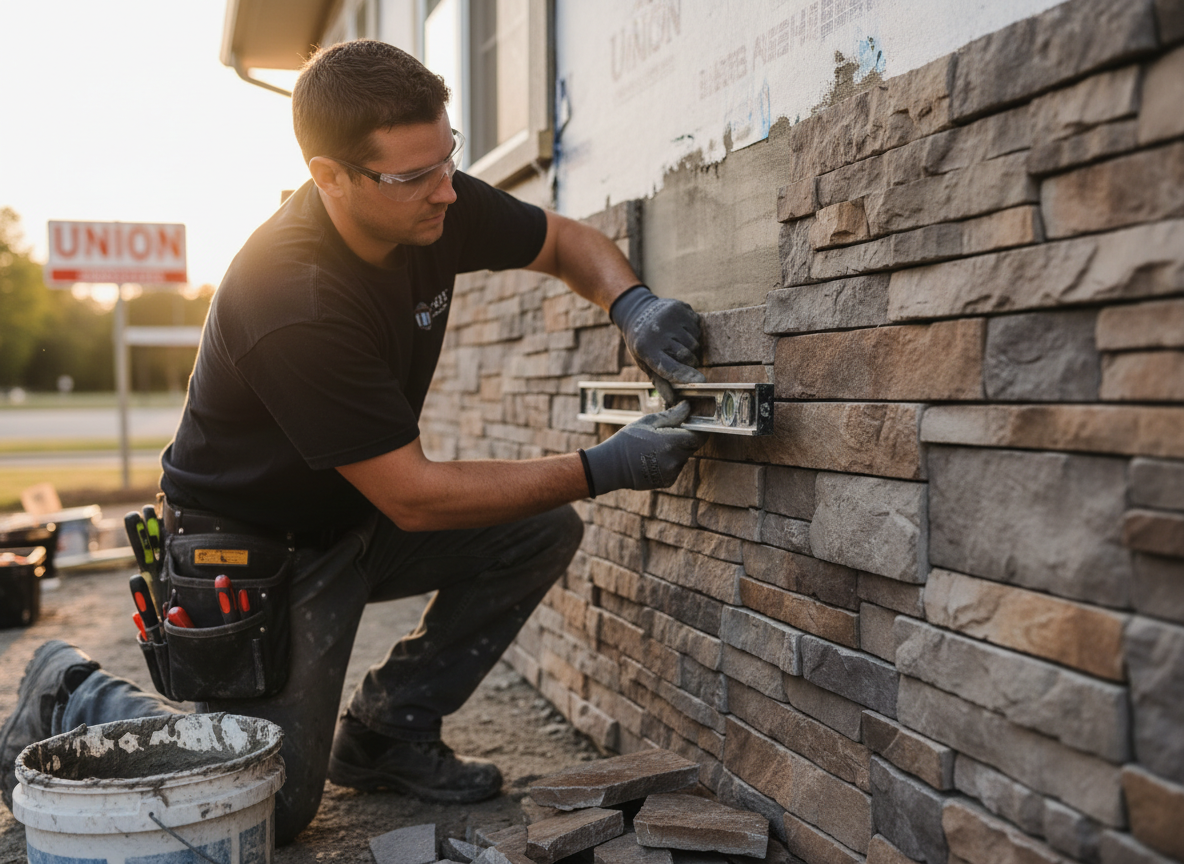
Faux stone siding in Boone County must handle the region's humid subtropical climate where mild winters still bring repeated moisture cycles. Homes in Union and Ryle often sit on older foundations with varying soil drainage, so installers add extra flashing at grade and use breathable housewrap rated for high humidity. Panels are fastened with stainless screws spaced to allow expansion without trapping condensation behind the surface, especially on north exposures near Union Community Park where shade keeps walls damp longer.
Material choice matters on local terrain. Lightweight polyurethane or fiber cement faux stone performs better than heavy precast on the rolling lots common between Union and Florence because it reduces load on aging sheathing. Edge detailing around windows and doors receives extra attention in Burlington-adjacent subdivisions where wind-driven rain can push water under trim if weep holes and drip edges are omitted. Proper ventilation channels behind the panels prevent mold growth during the long humid stretches typical after mild winters.
Code compliance in Boone County requires the siding system to maintain the required fire separation and drainage plane when applied over existing wood or vinyl. Crews remove failed underlayment entirely rather than overlaying new material, then verify the existing insulation remains dry before closing up. This step avoids callbacks when summer humidity spikes and reveals trapped moisture that would otherwise blister the faux stone surface.
Technician insight
In Union, the thing that catches most people out with faux stone siding is the combination of mild winter humidity and clay-heavy Boone County soil that holds moisture against the lower courses; skipping extra flashing at grade on Ryle homes lets water wick behind the panels within two seasons.
Faux Stone Refresh on North Wall
Home in Ryle showed blistering faux stone after several humid seasons. Inspection found missing flashing where siding met the foundation on the shaded side. Crew removed the failed section, added proper drainage plane and stainless fasteners, then reinstalled matching panels. The wall now sheds water and shows no new moisture after the next rain cycle.
How it works
- 1
Site Assessment
Measure elevations, check drainage around the foundation, and note exposure to prevailing winds near Union Community Park.
- 2
Moisture Barrier Installation
Apply rated housewrap and flashing at all transitions before any panels go up.
- 3
Panel Layout and Attachment
Set courses with expansion gaps and stainless fasteners suited to the local humidity swings.
- 4
Trim and Sealing
Install matching trim, weep holes, and caulk joints rated for Boone County temperature ranges.
- 5
Final Drainage Check
Test water flow at grade and confirm no pooling against the new siding.
Pricing
Upfront quotes after on-site inspection; material grade and wall access determine final cost.