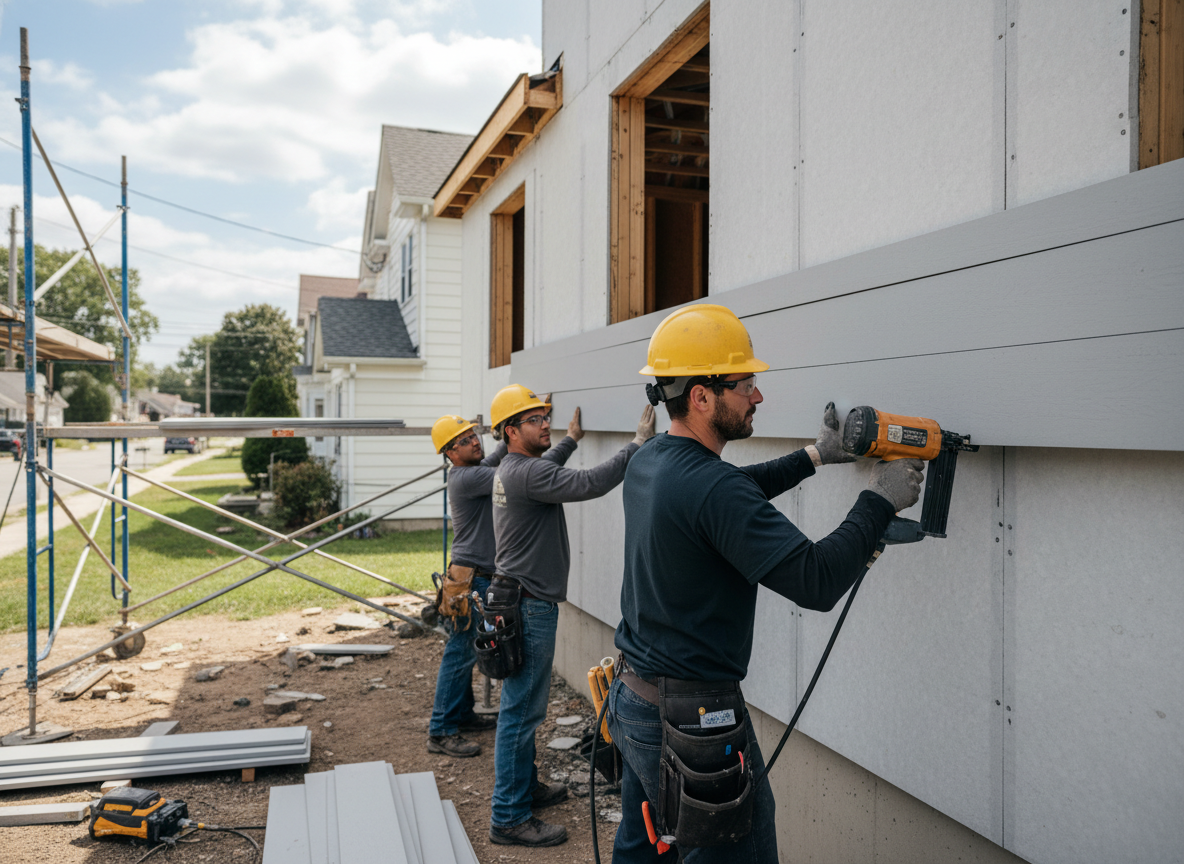
Fiber cement siding performs well in Boone County's humid subtropical climate where mild winters still allow moisture to linger. Proper joint sealing and flashing around windows become critical on homes in Union and Ryle because older wood-frame construction often lacks modern drainage planes. Installers must account for the material's weight when attaching to sheathing that may have softened over decades of exposure near Florence and Burlington.
Edge cases arise when replacing siding on split-level homes common along US-42 corridors. Fiber cement boards require precise spacing to allow for minor seasonal movement even in mild winters, and crews frequently discover hidden rot at the base of walls after removing original cladding. Matching existing trim profiles while upgrading to fiber cement demands custom cuts on site to maintain the look of established neighborhoods around Union Community Park.
Code notes in Boone County emphasize proper attachment schedules and vapor retarder placement behind the siding. Homeowners sometimes overlook the need for upgraded housewrap during full replacements, which can lead to callbacks when humidity drives moisture through older felt layers. Flux Mender inspects substrate conditions first because many Union properties built before 2000 have sheathing that needs localized repair before new boards go up.
Seasonal Guidance
Work in Union slows only slightly during the mild winter months, yet crews still schedule around occasional freezes that can affect adhesive curing on trim pieces. Spring humidity spikes make it essential to complete all caulking before pollen and moisture combine on fresh surfaces.
Technician insight
In Union, the thing that catches most people out with fiber cement siding contractors is underestimating how the mild winters and persistent humidity around Ryle homes let moisture sit behind poorly flashed windows. Many properties near Union Community Park still have original sheathing that softens after repeated cycles, so skipping a substrate check turns a straightforward swap into extra days of repair work.
Ryle Home Siding Replacement
Homeowner near Ryle noticed water stains inside after heavy spring rains. We found failed flashing and rotted sheathing under the old wood siding. After replacing damaged sections and installing fiber cement boards with updated drainage details, the interior stayed dry through the next humid season.
How it works
- 1
Site Assessment
Inspect existing siding, substrate and flashing on the Union or Ryle property to identify rot, drainage issues and attachment points.
- 2
Material Selection
Choose fiber cement profiles and colors suited to Boone County humidity and the home's existing architectural details.
- 3
Preparation and Removal
Remove old cladding, repair sheathing and install new weather-resistant barrier with proper overlaps.
- 4
Installation
Hang boards with manufacturer-specified fasteners, maintain expansion gaps and integrate new flashing at openings.
- 5
Finishing and Cleanup
Apply caulk at joints, paint or prime as needed and haul away debris from the job site.
Pricing
Upfront quotes follow a site visit to the Union address; final cost depends on square footage, substrate repairs and trim complexity.