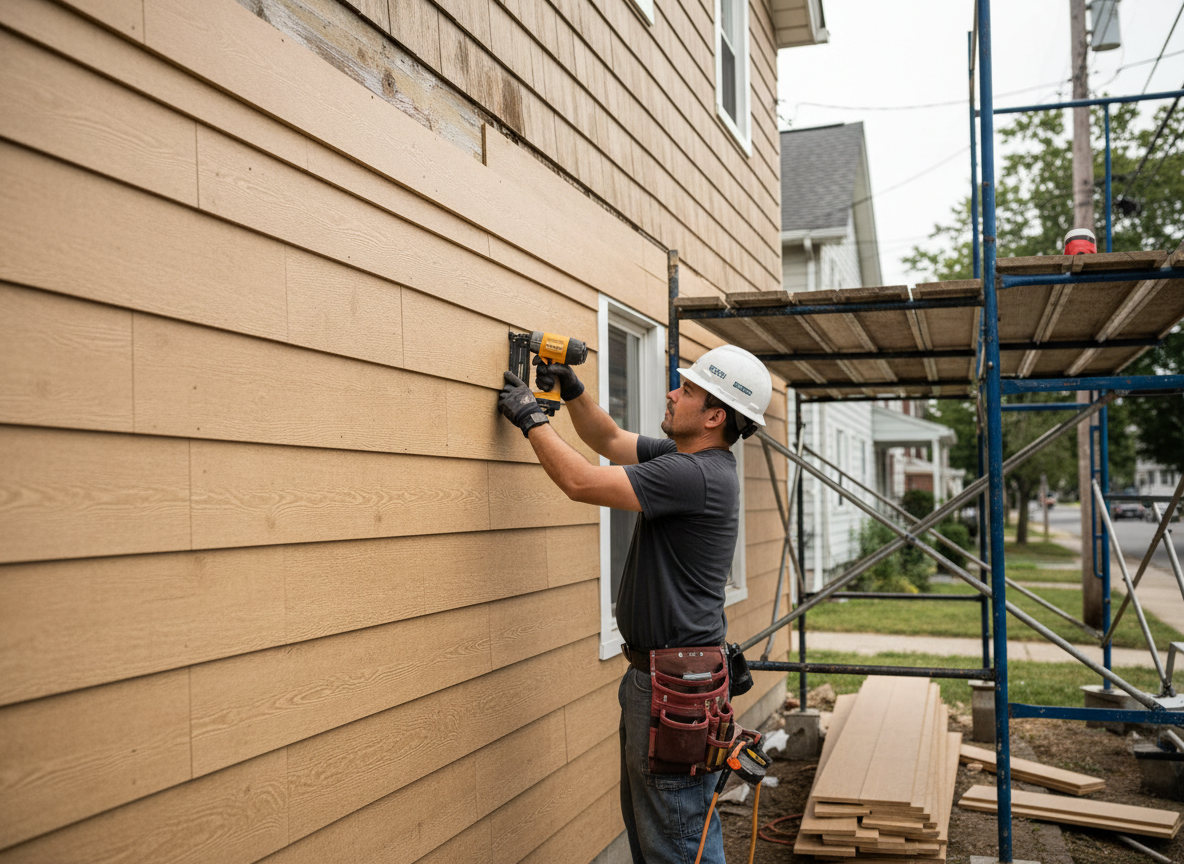
Hardboard siding appears on many homes built in Union and Ryle during the 1980s and 1990s. Boone County’s humid subtropical climate brings frequent rain and mild winters that keep siding surfaces damp for long stretches. This constant moisture causes hardboard to swell, delaminate, and cup along the bottom edges, especially on north-facing walls that receive less sun. Homeowners near Union Community Park often notice the problem first when paint begins to peel in vertical streaks.
Proper installation requires a minimum ¼-inch gap at all horizontal joints and full flashing behind every butt joint. In Florence and Burlington, many original installations skipped the Z-flashing detail, allowing water to wick upward into the board. When replacing sections we always install new housewrap, extend flashing past the joint by at least 2 inches, and prime every cut edge before nailing. Skipping these steps guarantees the same failure within three to five years.
Hardboard also expands and contracts more than fiber cement when temperatures swing between winter lows and summer highs. We leave slightly larger gaps at corners and around windows on homes in the Ryle area where afternoon sun can heat the surface quickly. Every repair includes a check of the weep holes at the bottom of the wall to keep trapped water from sitting against the foundation.
Edge Detailing That Prevents Rot
Hardboard fails fastest where it meets the ground or deck ledger. We always maintain a 6-inch clearance and install a metal drip edge that directs water outward rather than letting it run behind the bottom course.
Seasonal Timing for Union Projects
Mild winters allow year-round work, but spring and fall give the best curing conditions for caulk and paint. Summer humidity can slow drying enough that new hardboard edges absorb moisture before the finish is applied.
Technician insight
In Union, the thing that catches most people out with hardboard siding is how quickly water gets behind the bottom course when the original builder skipped the metal drip edge. Homes along US-42 and in Ryle sit on slightly sloped lots that send rain runoff right against the foundation, so the first boards to fail are almost always the lowest ones on the north side.
Bottom-Course Failure on a Ryle Home
Water had wicked up behind the lowest row of hardboard on a home off US-42 near Ryle. We found rotted sheathing and missing housewrap tape at the foundation. After replacing the bottom three courses, adding proper flashing, and restoring drainage away from the wall, the homeowner reported no further moisture issues through the next winter.
How it works
- 1
Site Inspection
We examine every elevation for swelling, delamination, and failed caulk lines while noting sun exposure and drainage around the foundation.
- 2
Material Removal
Damaged boards are cut out cleanly and any wet sheathing or housewrap is replaced before new hardboard is ordered.
- 3
Flashing and Prep
New flashing is installed at all joints and openings, edges are primed, and gaps are set to accommodate local humidity swings.
- 4
Installation and Finish
Boards are fastened per manufacturer spacing, caulked at seams, and two coats of exterior paint are applied with attention to north walls that stay damp longer.
Pricing
Pricing is based on the number of elevations affected and whether sheathing replacement is required; we provide an upfront written quote after the on-site inspection.