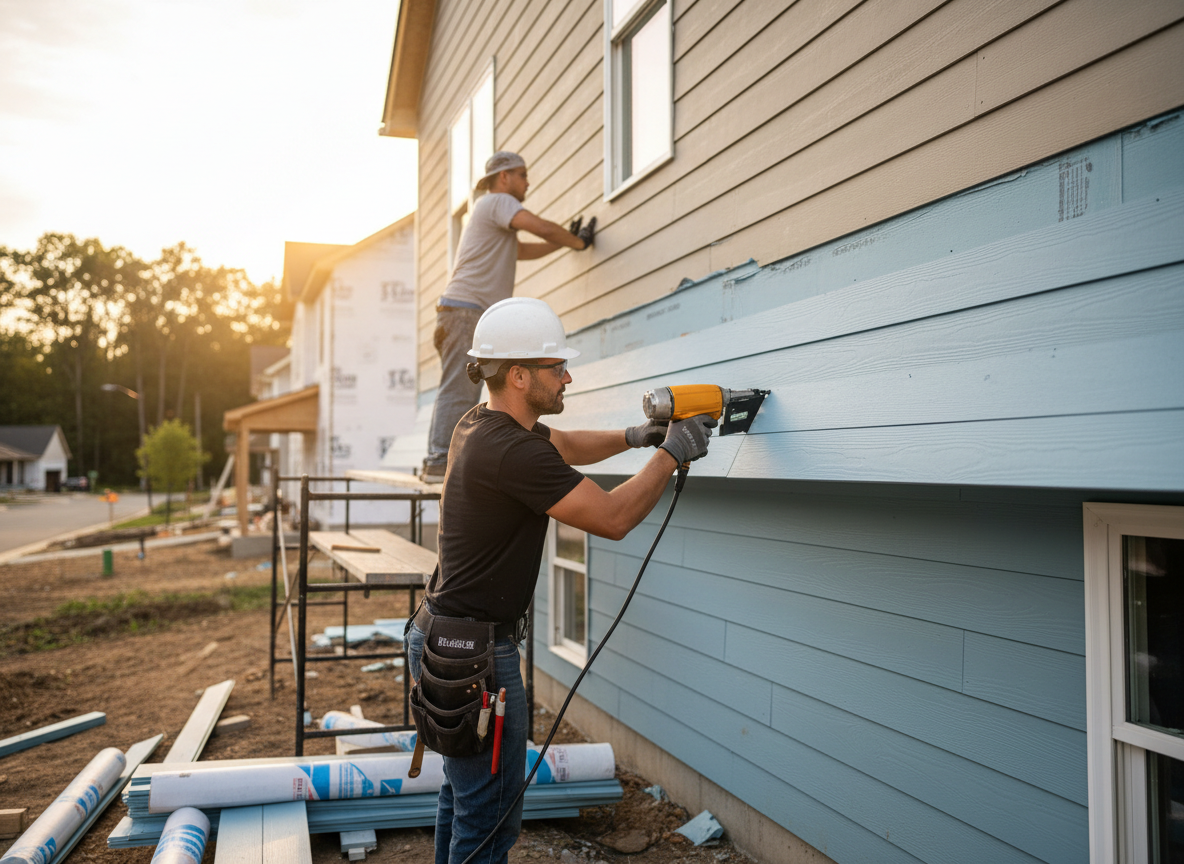
Union sits in Boone County where many homes in the Ryle area date from the 1990s and early 2000s with vinyl or aluminum siding that now shows fading and seam separation after repeated humid summers. Mild winters keep ground moisture high around foundations near Union Community Park, so siding jobs here routinely include checking for hidden rot along the bottom course before new panels go up. Fiber cement performs better than vinyl when humidity stays elevated through fall, while proper housewrap and flashing details prevent water from traveling behind the new surface during the next wet season.
Work in Florence and Burlington corridors often involves matching existing profiles on split-level homes where rooflines meet siding at different angles. Boone County permitting requires wind-load ratings that increase with each new layer added, so crews remove old material rather than overlay when the existing substrate shows cupping. Soil around Union tends to hold water after heavy rain, pushing installers to extend flashing farther down the foundation than in drier counties.
Homeowners in Ryle frequently discover that original builder-grade fasteners have corroded through after fifteen years, causing entire sections to loosen during routine pressure washing. Switching to stainless fasteners and adding a rainscreen gap behind the new siding reduces future callbacks in this climate. The 24/7 operation at 9039 US-42 lets crews respond the same day when a storm knocks loose panels on older homes along US-42.
Edge cases include tight property lines in Union subdivisions where scaffolding must be set without crossing into neighboring yards, and older homes where window trim was never properly integrated with the siding plane. Proper integration here means cutting new J-channel back to the sheathing rather than surface-mounting, which keeps water from pooling behind the trim during the humid months.
Technician insight
In Union, the thing that catches most people out with home siding contractors is how mild winters keep soil moisture high around foundations near Union Community Park, so any new siding without extended flashing and a rainscreen gap will trap water behind the bottom course within two seasons on 1990s homes in Ryle.
Ryle Split-Level Siding Refresh
A 1998 split-level in Ryle showed loose vinyl along the rear wall after repeated summer storms. Removal revealed rotted sheathing where original flashing stopped short of the foundation. New fiber cement was installed with a full rainscreen and extended flashing down to the footing. The homeowner avoided future rot calls during the next humid season.
How it works
- 1
Site Assessment
Walk the full exterior including foundation exposure and roofline transitions to identify moisture paths common in Boone County homes.
- 2
Material Selection
Review siding options against the home's age and exposure, noting how humid summers accelerate fading on south-facing walls in Union.
- 3
Removal and Prep
Strip failing layers, inspect sheathing, and install new housewrap with taped seams before any new panels are hung.
- 4
Installation and Detailing
Hang new siding with correct overlaps, install rainscreen where needed, and flash all penetrations to handle local moisture loads.
- 5
Final Walkthrough
Check every seam and corner with the homeowner and note any remaining trim or gutter adjustments required.
Pricing
Upfront quotes reflect material choice, home stories, and any substrate repairs uncovered during inspection.