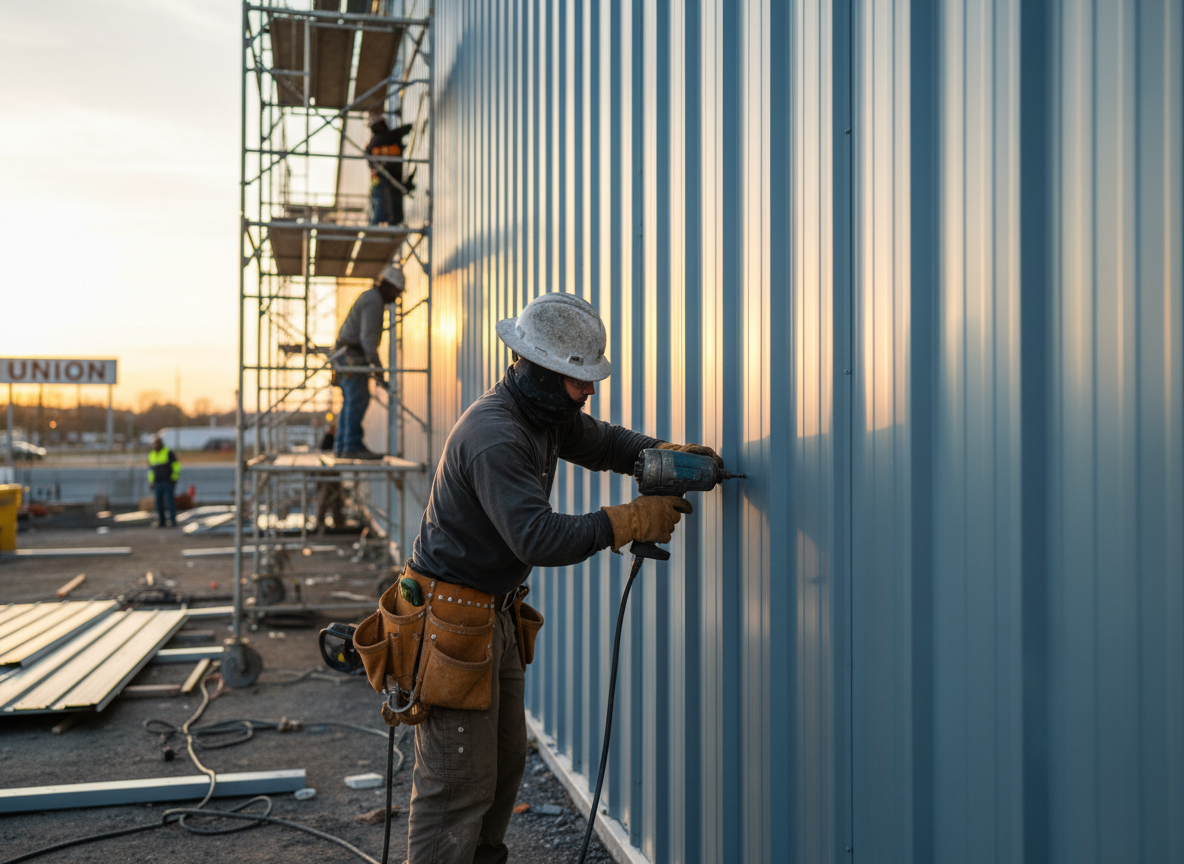
Union sits in Boone County where most homes built from the 1980s onward use wood or vinyl siding that shows wear from repeated humidity cycles. Metal siding offers a longer service life when the installer accounts for thermal movement and proper furring to prevent moisture trapping behind the panels. Crews working out of 9039 US-42 see frequent requests from Ryle neighborhoods and properties near Union Community Park where mature trees drop debris that can scratch finishes if not addressed during install.
Florence and Burlington homes often sit on slightly sloped lots that direct runoff toward foundations. Metal siding contractors must extend flashing at the base and integrate weep holes so condensation from mild winter nights can escape instead of pooling. Aluminum works well for coastal-style accents while 26-gauge steel handles the occasional high-wind gusts that reach Union from the Ohio River valley. Skipping these details leads to rust streaks within a few seasons.
Boone County permitting requires proper attachment into studs rather than sheathing alone, especially on older Ryle farmhouses converted to residential use. Installers check for hidden rot at window and door perimeters before hanging new panels. The 24/7 availability from the US-42 shop lets crews respond quickly when a sudden storm lifts a section and exposes the house to driving rain.
Seasonal Considerations
Metal siding jobs in Union slow during peak summer humidity because surface temperatures can exceed 140 degrees, making handling difficult and increasing expansion gaps needed at joints. Spring and fall remain ideal windows when mild temperatures allow precise alignment without condensation forming on the back side of panels.
Technician insight
In Union the thing that catches most people out with metal siding contractors is underestimating how the mild winters still produce enough nightly condensation on north-facing walls to rust fasteners if the back side lacks a proper air gap, especially on 1990s homes in Ryle where original sheathing has started to soften.
Ryle Home Base Flashing Repair
Water was entering at the bottom of the east wall after heavy spring rain. Inspection showed the original vinyl had trapped moisture against the sheathing on a slight slope toward Union Community Park. Crews removed the lower four feet, added extended metal flashing with weep holes, and reinstalled matching steel panels. The homeowner reported no further intrusion after the next several storms.
How it works
- 1
Site Assessment
Measure elevations, note existing substrate condition, and check drainage around the foundation on Union and Ryle properties.
- 2
Material Selection
Recommend gauge and finish based on sun exposure and proximity to trees near Union Community Park.
- 3
Preparation and Flashing
Remove damaged sections, install new furring strips, and extend base flashing to manage Boone County runoff.
- 4
Panel Installation
Hang panels with expansion allowances, seal penetrations, and integrate with existing trim on homes in Florence or Burlington.
- 5
Final Walkthrough
Inspect seams, confirm drainage, and review maintenance points with the homeowner.
Pricing
Cost depends on home square footage, chosen gauge, and any substrate repairs required on older Boone County houses.