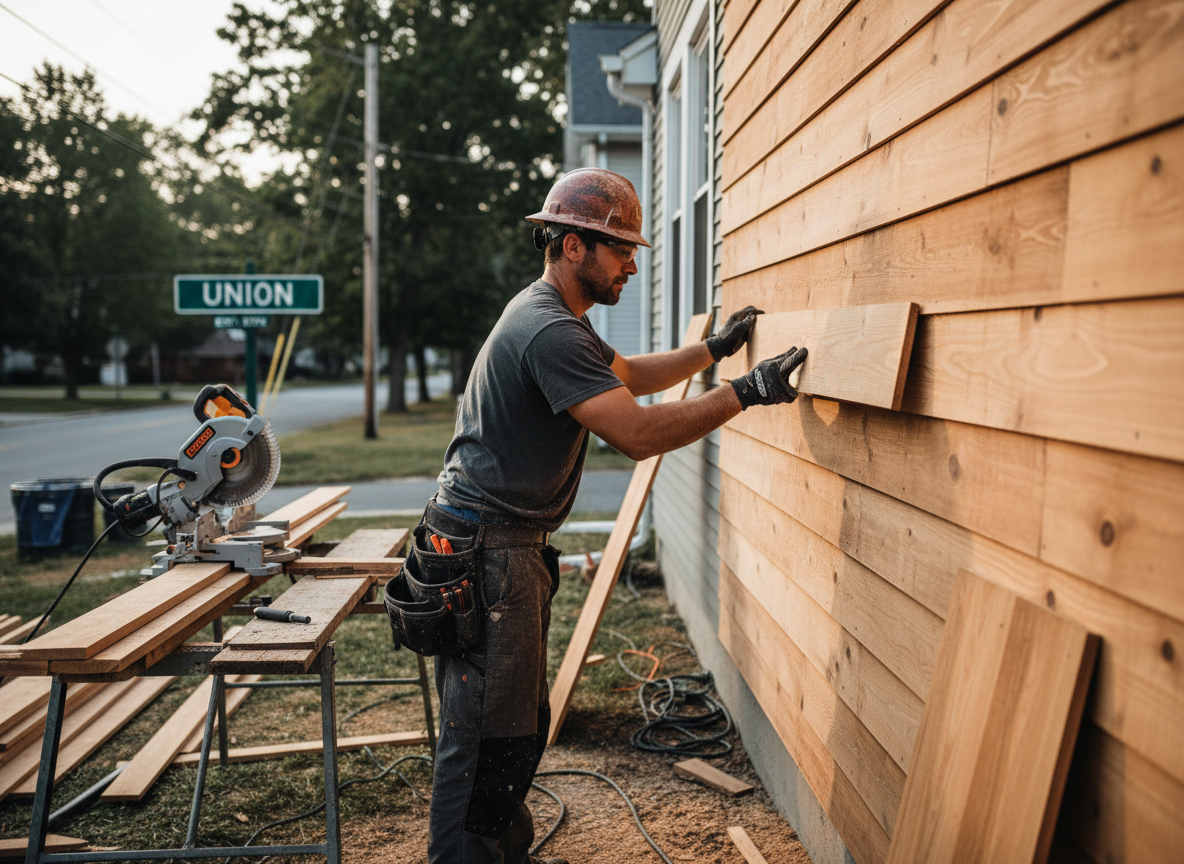
Wood siding on homes in Union and Ryle faces constant stress from Boone County's humid subtropical climate. Even mild winters allow moisture to linger behind boards, especially on north-facing walls of houses built before widespread use of modern housewrap. Cedar and pine react differently here, with cedar holding up better against repeated wet-dry cycles but still needing precise overlap and flashing at windows to prevent rot at the bottom courses.
Installation in this area requires removing old layers down to the sheathing on many properties near Union Community Park, where original 1980s and 1990s siding often sits directly on plywood without drainage gaps. We check for hidden water intrusion around electrical penetrations and HVAC lines, common failure points once temperatures swing from summer humidity into winter. Proper priming of all six sides of each board before hanging stops capillary wicking that homeowners rarely see until paint peels.
Code requirements in Boone County call for specific clearances above grade and at roof intersections that older Union homes frequently violate. Skipping these details during replacement leads to repeated callbacks within five years. We also address termite damage that travels upward through untreated bottom plates, a pattern we see regularly on properties along US-42 between Burlington and Florence.
Technician insight
In Union, the thing that catches most people out with wood siding is how our humid subtropical air and mild winters let moisture sit behind boards on the north side of 1980s-1990s homes in Ryle without obvious exterior signs until the bottom three courses start cupping.
Rotting Wood Siding on North Elevation
A Union home near Union Community Park showed paint failure along the lower north wall. We found saturated sheathing and missing flashing at the foundation. After replacing damaged sections and adding proper drainage gaps, the new cedar boards were installed with full back-priming. The homeowner now has siding that sheds water instead of trapping it through the next winter.
How it works
- 1
On-Site Assessment
We examine every elevation, probe suspect boards, and document moisture levels around windows and corners on your Union or Ryle property.
- 2
Material Selection And Prep
Boards are chosen for local humidity exposure, primed on all sides, and cut to length before any old siding is removed.
- 3
Removal And Substrate Repair
Damaged sheathing and housewrap are replaced, drainage gaps added where missing, and flashing corrected at all transitions.
- 4
Installation And Finishing
New wood siding is hung with proper overlaps, caulked at joints, and given two coats of exterior paint matched to existing colors.
Pricing
Upfront written quotes after inspection; final price depends on extent of substrate damage and access.